

Writing a Dissertation is an Important Academic Task that Requires Careful Planning and Detailed Research
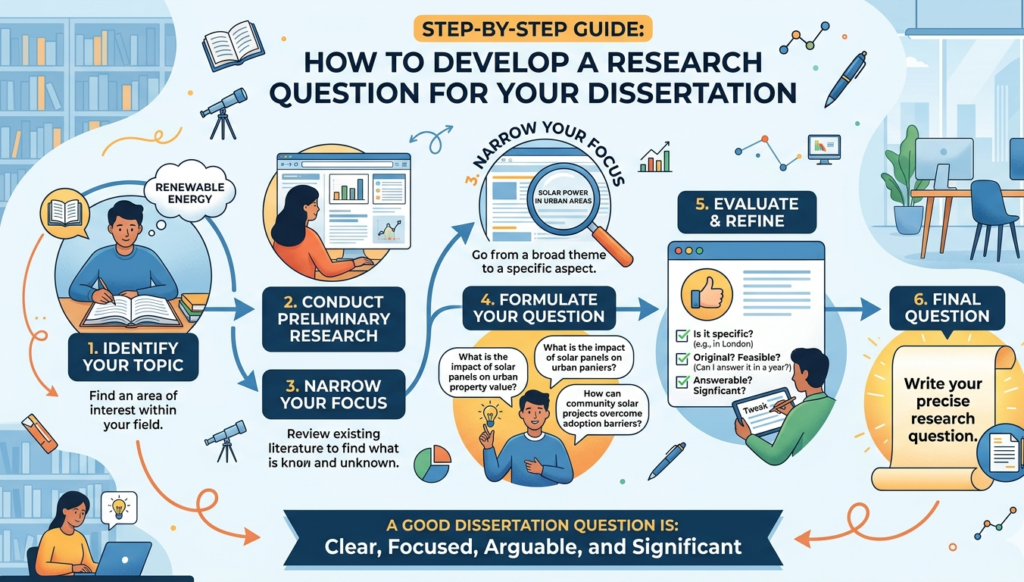
One of the most essential parts of this process is developing a strong research question. A research question is the central focus of your dissertation because it guides your research, shapes your arguments, and determines the direction of your study. A clear and well-structured research question helps students stay focused and ensures that the research remains meaningful and organized.
Step 1: Choose a Topic That Interests You
The first step in developing a research question is choosing a topic that interests you. Since writing a dissertation can take several months, selecting a topic you are passionate about will help you stay motivated throughout the research process. Your topic should also be relevant to your field of study and should contribute to existing academic discussions. For example, students in media studies may explore topics related to digital communication, social media influence, or audience behavior.
Step 2: Conduct Preliminary Research
After selecting a general topic, the next step is conducting preliminary research. This involves reading books, academic journals, articles, and previous research studies related to your topic. Preliminary research helps you understand what information already exists and what areas still need further exploration. By reviewing the existing literature, you can identify research gaps that have not been fully studied. These gaps often become the foundation for forming a strong research question.
Step 3: Narrow Your Topic
Another important step is narrowing your topic. Many students start with very broad ideas, which can make the research difficult to manage. A good research question should be specific and focused. For example, instead of asking “How does social media affect people?” you could ask a more specific question like “How does social media influence the study habits of university students?” A focused question makes it easier to collect relevant data and conduct a detailed analysis.
Step 4: Ensure Your Question is Clear and Researchable
Your research question should also be clear and researchable. This means it should be possible to answer the question through proper research methods such as surveys, interviews, or data analysis. Avoid questions that only require simple yes or no answers. Instead, try to create questions that begin with “how,” “why,” or “to what extent,” because these types of questions encourage deeper research and critical thinking.
Step 5: Consider the Feasibility of Your Research Question
It is also important to consider the feasibility of your research question. Students should think about whether they have enough time, resources, and access to information to answer the question effectively. If a research question requires data that is difficult to obtain, it may need to be modified or simplified. A realistic research question makes the entire dissertation process easier and more manageable.
Step 6: Seek Feedback From Your Supervisor
Another useful step is seeking feedback from your supervisor or academic advisor. Supervisors have experience guiding research projects and can help students refine their research questions. They may suggest improving the wording, narrowing the focus, or adjusting the research scope. This feedback is valuable because it ensures that the research question meets academic standards.
Conclusion
Developing a strong research question is a crucial step in writing a successful dissertation. By choosing an interesting topic, conducting background research, narrowing the focus, ensuring the question is clear and researchable, and seeking guidance from supervisors, students can create an effective research question. A well-developed research question helps guide the entire research process and increases the chances of producing meaningful and valuable academic work.