

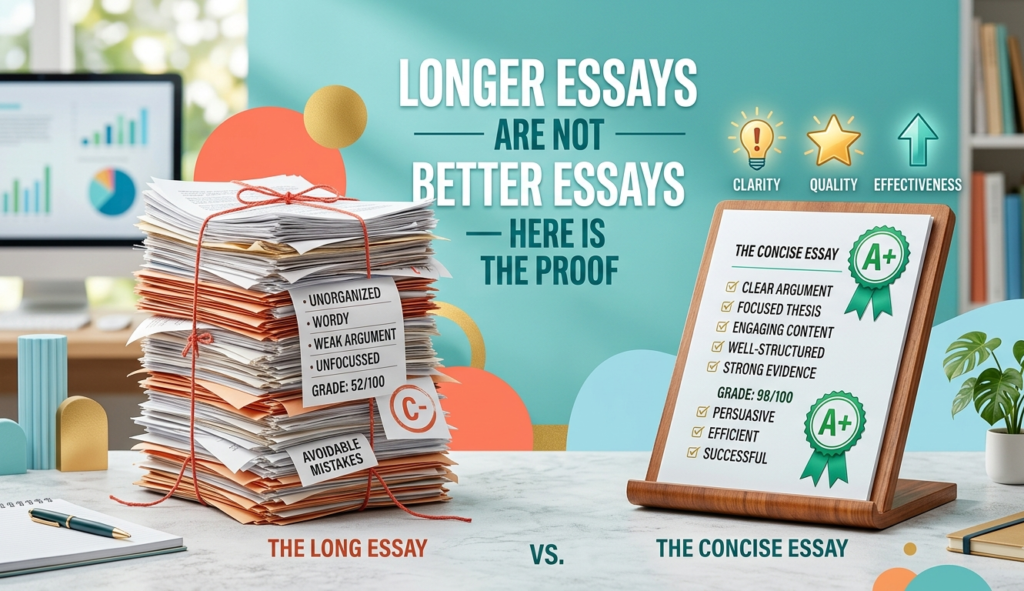
There is a stubborn myth in writing that length signals effort, and effort signals quality. Students pad paragraphs to hit word counts. Professionals bulk up reports to appear thorough. But here is the uncomfortable truth: length is not a measure of excellence. Clarity is.
The Word Count Trap
Most of us were trained to associate length with value. A five-page essay felt more serious than a two-page one. A 2,000-word report seemed more credible than a 600-word summary. Schools reinforced this by setting minimum word counts rather than minimum standards of thought.
The result? Writers learned to stretch, not sharpen. Vague transitions, redundant examples, and hollow qualifiers became survival tools. “It is important to note that…” adds nothing. “In conclusion, as we have seen throughout this essay…” wastes the reader’s final seconds. These phrases exist to fill space, not serve meaning.
What the Research Actually Shows
Studies on reading comprehension consistently find that concise writing is better understood and better retained. A 2016 study published in Applied Cognitive Psychology found that readers recall the core argument of shorter, well-structured texts more accurately than longer ones on the same topic. The reason is simple: every unnecessary sentence is a cognitive tax on the reader.
Beyond academia, the business world has learned this lesson expensively. McKinsey, one of the world’s most influential consulting firms, trains its analysts in a method called the Pyramid Principle, leading with the conclusion and ruthlessly cutting anything that doesn’t support it. The goal is never a longer memo. It is a clearer one.
The Illusion of Depth
Padding creates the illusion of depth without the substance. Consider two writers explaining the same concept. One writes 1,200 words circling the idea, restating it from five angles, adding a historical digression, and closing with a broad philosophical reflection. The other writes 400 words that define the concept precisely, give one sharp example, and draw a clear implication.
The second writer understood it better. Compression requires mastery. You cannot distil an idea to its essence if you don’t fully understand it. Vagueness hides behind volume.
When Length Is Earned
This is not a case against long writing. Some ideas are genuinely complex and demand space. A long-form investigation, a nuanced policy analysis, or a layered personal essay can justify every word if each one is doing real work. The test is not length, it is necessity. Can you cut this sentence without losing meaning? If yes, cut it.
Ernest Hemingway, one of the most studied prose stylists in English, built his reputation on what he left out. His iceberg theory holds that the power of a piece comes from what lies beneath the surface, not from piling more on top.
The Standard Worth Adopting
Next time you finish a draft, don’t ask “Is this long enough?” Ask “Is every sentence earning its place?” Read it aloud. Find the moment the reader’s attention would drift. Cut there. Then cut again.
The writers who are remembered are rarely the ones who wrote the most. They are the ones who said exactly what needed to be said, and stopped.
That is the proof. The best essays are not the longest ones. They are the ones you finish wishing there were more.