

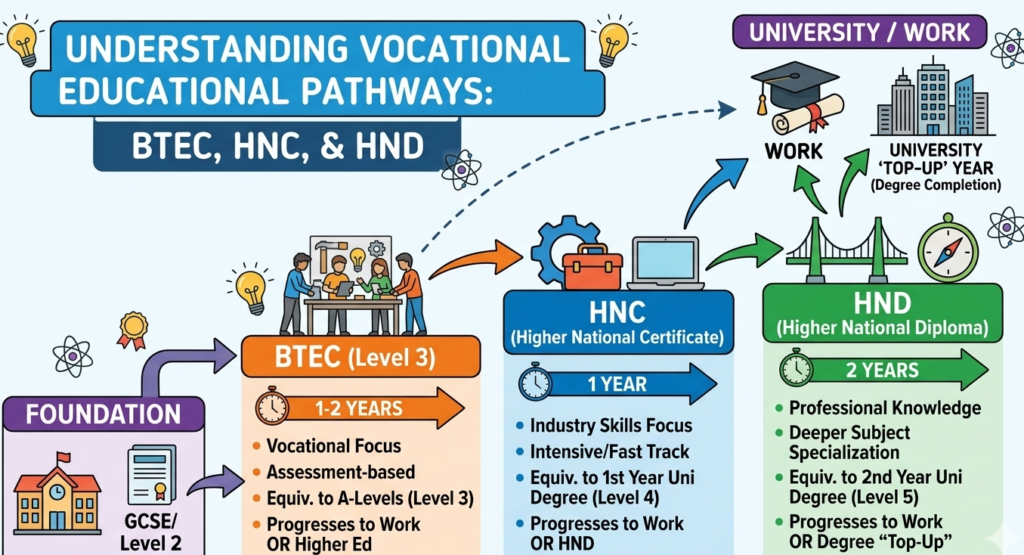
Choosing the right qualification can be confusing for students who want practical, career-focused education. Three popular vocational qualifications often compared are **BTEC**, **HNC**, and **HND**. While all three focus on developing practical skills and industry knowledge, they differ in level, duration, and academic progression. Understanding these differences can help students choose the pathway that best suits their career goals.
What is a BTEC?
A BTEC (Business and Technology Education Council)** qualification is a vocational course designed to provide practical learning alongside theoretical knowledge. BTECs are widely offered in schools, colleges, and training institutes and are available at different levels, such as BTEC Firsts, Nationals, and Higher Nationals.
BTEC courses are assessed mainly through coursework, assignments, and practical projects rather than final exams. This makes them suitable for students who prefer continuous assessment instead of traditional exam-based learning. BTECs cover a wide range of subjects including business, engineering, health and social care, media, and IT.
Students usually take BTEC Nationals after completing secondary education. These qualifications are equivalent to A-levels and can lead to university admission or direct entry into the workforce.
What is an HNC?
An **HNC (Higher National Certificate)** is a higher education qualification that focuses on developing specialized knowledge and technical skills related to a particular industry. HNC courses are typically offered by colleges and some universities.
An HNC usually takes **one year of full-time study** or **two years part-time** to complete. It is considered a **Level 4 qualification** in the UK education system, which is equivalent to the first year of a university degree.
HNC programs are commonly available in fields such as engineering, construction, computing, business, and hospitality. The course structure combines classroom learning with practical assignments and projects. After completing an HNC, students can either enter employment or continue their studies by progressing to an HND.
What is an HND?
An **HND (Higher National Diploma)** is a more advanced qualification than an HNC and is designed to provide deeper knowledge and practical expertise in a specific subject area. It is considered a **Level 5 qualification**, which is equivalent to the **second year of a bachelor’s degree**.
HND courses usually take **two years of full-time study** to complete. In many cases, students who finish an HND can progress directly into the **final year of a university degree**, often referred to as a “top-up degree.”
Like HNC programs, HND courses focus heavily on practical learning, coursework, and industry-relevant projects. This makes them ideal for students who want both academic knowledge and hands-on experience.
Key Differences Between BTEC, HNC, and HND
The main difference between these qualifications lies in their **level and academic progression**. BTEC qualifications are available at different levels and often serve as a foundation for higher education. In contrast, HNC and HND are higher education qualifications that are more specialized and career-focused.
Another difference is the **duration of study**. BTEC courses can vary in length depending on the level, while HNC typically takes one year and HND takes two years. Additionally, HND provides a higher qualification than HNC and allows easier progression to a full bachelor’s degree.
Finally, while all three emphasize practical learning, HNC and HND are more advanced and industry-specific compared to many BTEC programs.
Conclusion
BTEC, HNC, and HND qualifications all provide valuable alternatives to traditional academic routes. BTEC courses are ideal for students starting their vocational education, while HNC and HND programs offer more advanced, specialized training that can lead directly to employment or further university study. By understanding these differences, students can choose the qualification that best supports their academic journey and future career ambitions.