

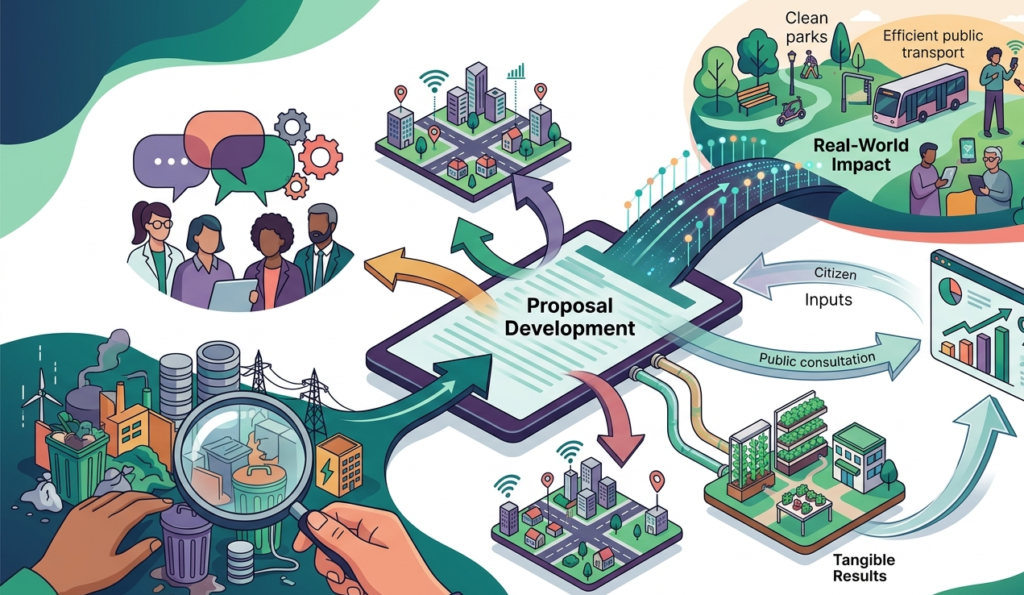
A research proposal can be methodologically flawless and still fail to persuade. Reviewers today are not only asking “is this rigorous?” They are asking “why does this matter beyond academia?” Learning to answer that second question well is often what separates a funded proposal from a rejected one.
Lead With the Real Problem
Too many proposals bury their significance under pages of background theory. By the time the reader reaches the “so what,” interest has already faded. Reverse this pattern. Open with the tangible issue your research responds to: a shortage in healthcare delivery, an outdated regulation, a recurring failure in an industry process, or an unmet need in a specific community.
A useful test is this: could you explain the core problem to a friend outside your field in two or three sentences? If not, the proposal likely needs sharper framing before it goes anywhere near methodology.
Identify Who Benefits
Impact becomes believable when it is attached to real people or institutions. Rather than writing broadly about contributing to “the field,” name the groups who would use your findings, such as policymakers, practitioners, educators, or affected communities. Describe what decisions or practices your research could shape.
This step does not weaken the academic contribution of the work. It simply places that contribution next to a practical one, giving reviewers two reasons to care instead of one.
Anchor the Case With Current Evidence
Relevance is strengthened by timing. Bring in recent statistics, policy changes, or emerging patterns that show the problem is active right now, not a hypothetical concern. If a law is due for revision, if adoption of a new technology is outpacing safeguards, or if a public health trend is accelerating, make that visible early in the proposal. Urgency gives your work a reason to be prioritized.
Map the Route From Results to Use
Reviewers want to imagine what happens after the study ends. Will the findings feed into a set of clinical guidelines, a policy recommendation, a redesigned process, or a training curriculum? Even a brief outline of this path shows that you are thinking beyond the final report.
Partnerships help here as well. If a government office, nonprofit, hospital, or company is involved in the project, say so. Their participation is tangible proof that the research is tied to practice and not confined to theory.
Stay Honest About What the Work Can Deliver
There is a temptation to inflate applied claims to make a proposal sound more urgent. This usually backfires. Experienced reviewers notice when conclusions are stretched beyond what the methodology can support, and that gap damages trust in the entire proposal. A precise, well grounded claim of relevance holds up far better than an ambitious one that collapses under scrutiny.
End With Meaning, Not Repetition
Avoid closing your proposal with a dry restatement of objectives. Instead, circle back to the real world problem you began with and describe, briefly, what changes if your research succeeds. It need not be grand. Pointing to better outcomes, fairer access, or a safer process is often enough to remind reviewers what is at stake.
A Final Note
Grounding a proposal in real world relevance is not a departure from scholarly seriousness. It is an extension of it. When a reviewer can trace a clear line from your research question to a concrete outcome, your proposal is judged not only on how interesting it is, but on how necessary it is.