

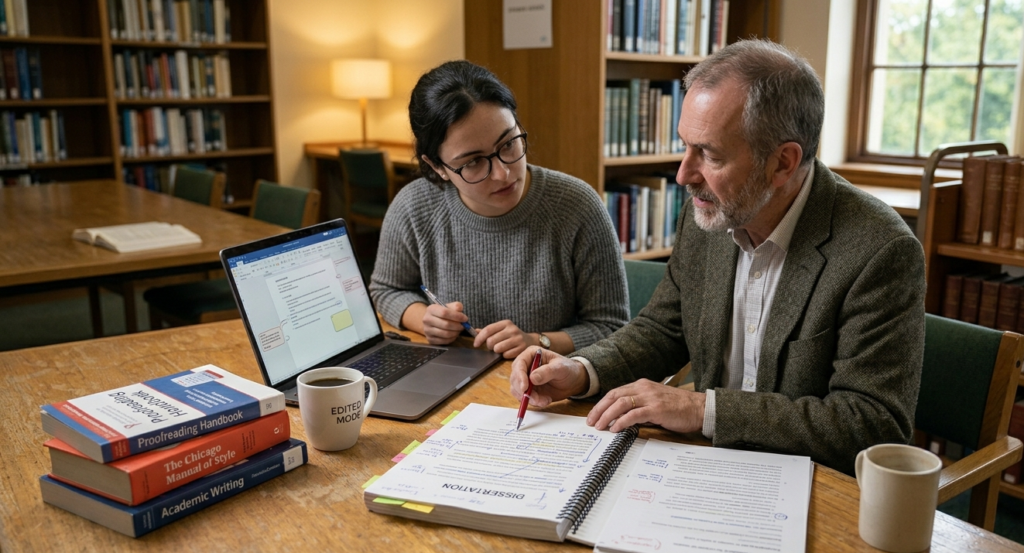
You have spent months perhaps years, researching, drafting, and refining your dissertation. Yet many students underestimate the final stage: editing and proofreading. Submitting a well-argued dissertation riddled with grammatical errors or structural inconsistencies can undermine all that effort. Here is a practical guide to editing and proofreading your dissertation effectively.
1. Take a break before you begin
One of the most common mistakes is jumping straight into editing immediately after writing. Your brain has been too close to the material, making it easy to miss errors. Step away for at least 24 to 48 hours before you begin revising. This mental reset allows you to read your work with fresh eyes and spot issues you would otherwise overlook, unclear sentences, logic gaps, and repeated words all become far more visible with distance.
2. Edit in stages, not all at once
Trying to fix everything in a single pass is overwhelming and ineffective. Instead, break editing into clearly defined stages. Start with a structural edit: read each chapter to check whether your argument flows logically, your sections are balanced, and your research questions are answered. Only once the big picture is solid should you move to sentence-level editing, tightening wordy phrases, improving clarity, and varying sentence length. Doing both simultaneously leads to fatigue and missed mistakes.
Pro tip
Print out your dissertation, or change the font and page layout digitally. A visual change helps your brain process the text differently, catching errors that are invisible on-screen.
3. Check your argument and structure
Good proofreading goes beyond grammar. Re-read your introduction and conclusion side by side, do they align? Your conclusion should directly address what you promised in the introduction. Verify that each chapter has a clear purpose and that your topic sentences guide the reader through your argument. Check that all claims are supported by evidence, and that your transitions between sections flow naturally rather than feeling abrupt.
4. Focus on academic language and tone
Dissertations demand a formal, objective tone throughout. Eliminate casual language, contractions, and first-person opinion phrases such as “I think” or “I believe” unless your methodology explicitly calls for reflexivity. Watch for hedging language that weakens your argument, phrases like “it could perhaps be argued” can often be shortened to “it can be argued.” Precision matters: replace vague terms with specific academic vocabulary appropriate to your discipline.
5. Proofread for grammar, spelling, and punctuation
Once your content and tone are sound, conduct a thorough proofread for surface-level errors. Read slowly, ideally out loud, your ear will catch awkward phrasing your eye misses. Pay close attention to subject-verb agreement, comma usage, and consistent tense throughout each chapter. Do not rely solely on spell-check tools; they miss context-dependent errors, such as “their” versus “there,” or discipline-specific terminology flagged incorrectly as misspelled.
6. Verify citations and formatting
Citation errors are among the most common issues examiners flag. Cross-check every in-text citation against your reference list to ensure nothing is missing or misformatted. Confirm you have followed your required citation style, APA, Harvard, Chicago, or other, consistently throughout. Also review your formatting: check heading levels, page margins, font size, and line spacing against your institution’s submission guidelines. Small formatting inconsistencies can create a poor overall impression.
7. Seek a second reader
After several rounds of self-editing, it is extremely difficult to remain objective. Ask a trusted peer, colleague, or academic writing tutor to read your work. A fresh perspective often uncovers issues that have become invisible to you. Provide your reader with specific feedback questions, for example, “Is my argument clear in chapter three?” rather than a vague request for general comments. This produces more useful, targeted feedback.
Conclusion
Editing is not simply about correcting mistakes — it is about ensuring your hard work communicates your ideas as clearly and persuasively as possible. Build sufficient time into your submission schedule for multiple editing passes, and treat each stage as a distinct, important part of the writing process. A well-edited dissertation reflects not just intellectual effort, but professional care.