

Why most topics fail before they start
Every year, thousands of students across UK universities, from Russell Group institutions to post-92s, invest enormous energy into research topics that were either already exhausted, too narrow to matter, or too broad to be practical. The problem is rarely intelligence. It is almost always a lack of early-stage scrutiny.
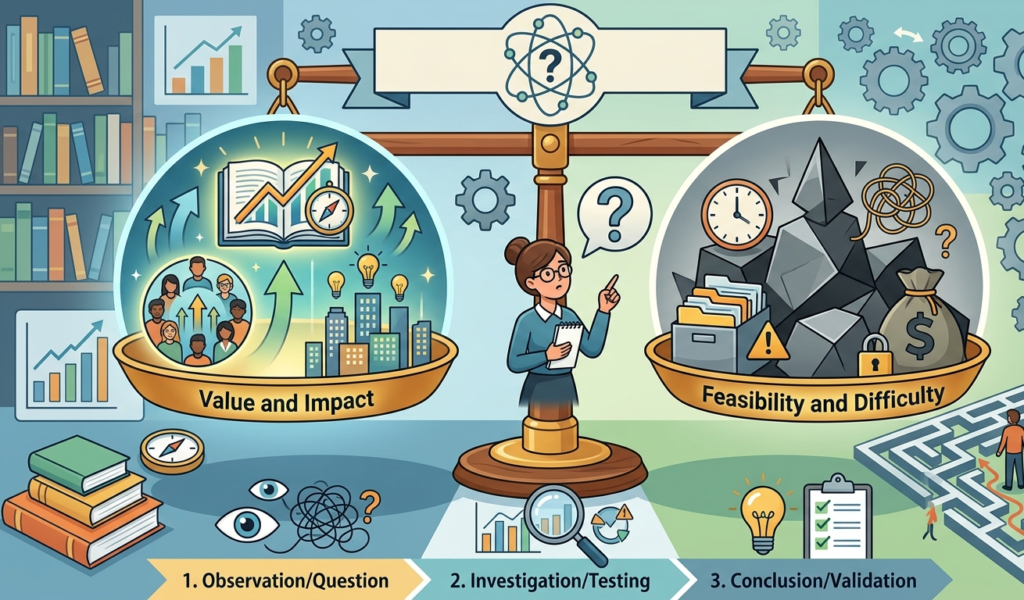
Whether you are writing a dissertation for your undergraduate degree, a master’s thesis, or applying for a UK Research and Innovation (UKRI) grant, the same questions apply. Is this genuinely unexplored? Does anyone care about the answer? Can you actually do it?
- Is there a gap in the existing literature? Search Google Scholar, JSTOR, and the British Library’s EThOS (the UK’s national thesis database). If you find more than a dozen papers addressing your exact question, you need to refine it, not abandon it, but sharpen the angle.
- Does it matter to someone beyond your supervisory panel? Think about real-world relevance policy, industry, community. Topics that align with UKRI priority areas (such as net zero, public health, or digital economy) tend to attract more funding and more engaged examiners.
- Is it achievable within your constraints? Time, budget, access to participants, and ethical clearance are all real limits. A well-scoped modest study beats an ambitious one that collapses under its own weight.
- Can you formulate a clear research question? If you cannot write your core question in one sentence, the topic is not ready. Vague topics produce vague findings.
- Do you have the methodological skills, or can you learn them? A topic requiring advanced quantitative analysis is a poor choice if you have no statistical background and no time to build one. Be honest with yourself early.
Choosing a topic because it is personally interesting, without checking whether it is academically or professionally significant. Your passion matters, but passion alone does not constitute scholarly contribution.
Signs your topic is genuinely worth pursuing
Strong topics often sit at the intersection of a gap in knowledge and a real-world need. In the UK context, consider how your research aligns with national priorities, whether that is improving NHS outcomes, understanding post, Brexit trade patterns, or exploring educational inequality in comprehensive schools. Relevance is not a concession to pragmatism; it is what makes good research matter.
When to pivot, not abandon
A reality check is not a death sentence. Most topics fail not because the core idea is wrong, but because the framing is too wide or the question too general. Narrowing your geographical focus to England or Wales, restricting your time period, or shifting from a descriptive to an explanatory approach can transform a weak topic into a compelling one.
Talk to your personal tutor or supervisor early. In UK higher education, supervisory relationships are often underused, most academics are genuinely glad to discuss topic viability before you have invested heavily. Use them.
The best research topics are not necessarily the grandest. They are the ones that ask a precise question, sit within a genuine gap, and can actually be answered. Run the reality check now, your future self will be grateful you did.