

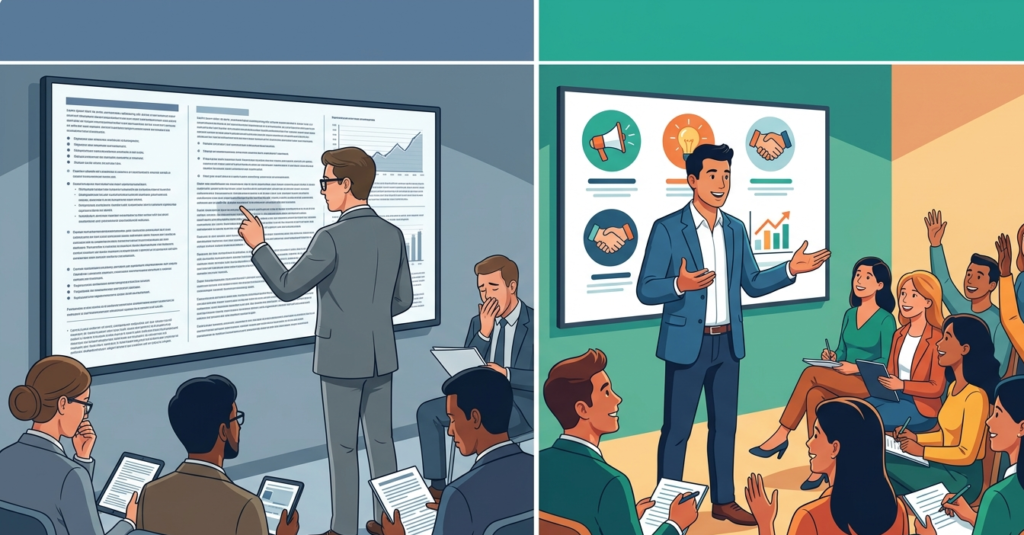
There is a particular kind of suffering familiar to anyone who has sat in a conference room or a lecture hall, watching a presenter turn their back to the audience and read , word for word, every bullet point on the screen behind them. You already read it yourself in two seconds. Now you must endure it again, spoken aloud, at a slower pace, by someone holding a clicker. This is not presenting. This is narrating a document nobody asked to be read to.
The distinction matters more than most people realise.
The Slide Was Never Meant to Be a Script
A presentation slide is a visual anchor, not a teleprompter. Its job is to hold the audience’s attention in the right place while the speaker adds dimension, context, nuance, story, and conviction, that the slide itself cannot carry. When a presenter reads directly from the screen, they collapse those two roles into one, and the result is worse than either a good speech or a well-written document would have been on its own.
The audience ends up in a strange limbo: passive enough to feel bored, but not settled enough to read at their own pace. They are being managed, not engaged.
Why It Happens
Most people read off slides because they are anxious, underprepared, or both. The slides become a safety rope, a guarantee that there is always something to say next. This is understandable. Public speaking is genuinely uncomfortable, and the temptation to lean on the screen is strong precisely when the stakes feel high.
But anxiety is not the only culprit. The culture of “deck-as-deliverable” where the slide deck doubles as the leave-behind document and the live presentation, practically forces presenters into this trap. When a slide has to function as a standalone document, it fills with text. When it fills with text, reading it becomes almost inevitable.
The solution to that problem is not better slide design alone. It is a clearer understanding of what a presentation is actually for.
What Presenting Actually Requires
A real presentation is an act of translation. The presenter has spent time with an idea, studying it, wrestling with it, forming a view, and their job is to transfer some of that understanding, and some of that conviction, into the room. That cannot happen through recitation. It happens through eye contact, through the deliberate pause before an important point, through the aside that is not on any slide but that everyone in the room will remember.
When you present well, the slides become almost incidental. The audience trusts you first. The slides simply confirm that trust is well placed.
The Fix Is Not Complicated
You do not need to memorise your entire presentation. You need to know it well enough to talk about it naturally, the way you would explain it to a colleague over coffee. Rehearse by speaking it aloud, not by re-reading your notes. Reduce the text on each slide until the bullet points are triggers for your thinking, not transcripts of it.
And when you stand up to speak, face the people in the room. The screen is behind you. The audience is in front of you. That orientation, simple as it sounds, is the whole point.
Reading off your slides tells your audience that the document is the presentation. Standing in front of people, knowing your material, and bringing it to life tells them something quite different: that you believed it was worth their time to be there.
That is the difference between narrating and presenting. One of them respects the room. The other merely fills it.